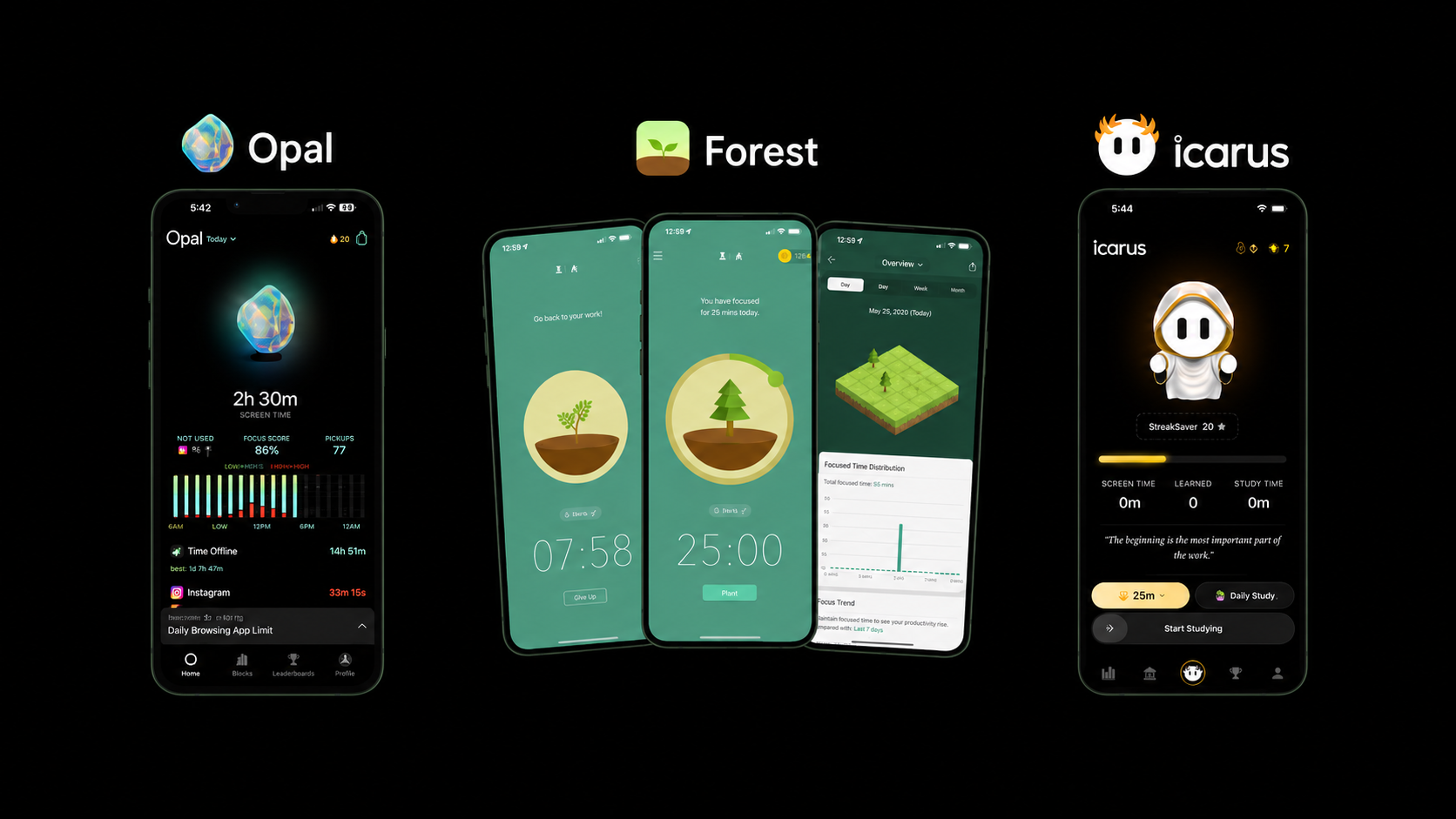
I’ve had Opal, Forest, and Icarus on my phone at the same time, which is a slightly ridiculous sentence to write but it’s the most honest way I can compare them — I wasn’t testing these from the outside, I was trying to solve my own problem and kept installing new attempts at a fix.
Here’s the short version: all three block your apps. Only one of them gave me anything back for the time I spent locked out.
What Opal actually does
Opal is a scheduling-first blocker. You set “sessions” — blocks of time where selected apps are locked — and it tracks your screen time with clean, Apple-style charts. It’s genuinely well-designed, and if the problem you’re solving is “I want a strict, good-looking timer that locks Instagram from 9pm to 11pm,” it does that better than most.
What it doesn’t do is anything with the time it’s protecting. You get the lock and a chart of how well you kept it. Nothing about what you were supposed to be doing in that window comes into the app at all.
It’s also insanely easy to bypass. There is no real friction to exiting a “focus session.” Wait 5 seconds and you’re back to scrolling.
What Forest actually does
Forest’s whole mechanic is a virtual tree that grows while you stay off your phone, and dies if you leave the app. It’s the most viral of the three for a reason — the guilt of killing a tree is a genuinely clever hook, and it got me to put my phone down for a solid few days when I first tried it.
The problem is the hook is the entire product. Once the novelty of the tree wears off — and it wears off fast, this isn’t unique to Forest, it’s true of any single gamification gimmick — you’re left with a countdown timer wearing a plant costume. It doesn’t know what you’re studying, doesn’t know if you’re behind in a class, and doesn’t get better at helping you over time. It just counts.
Where Icarus is actually different
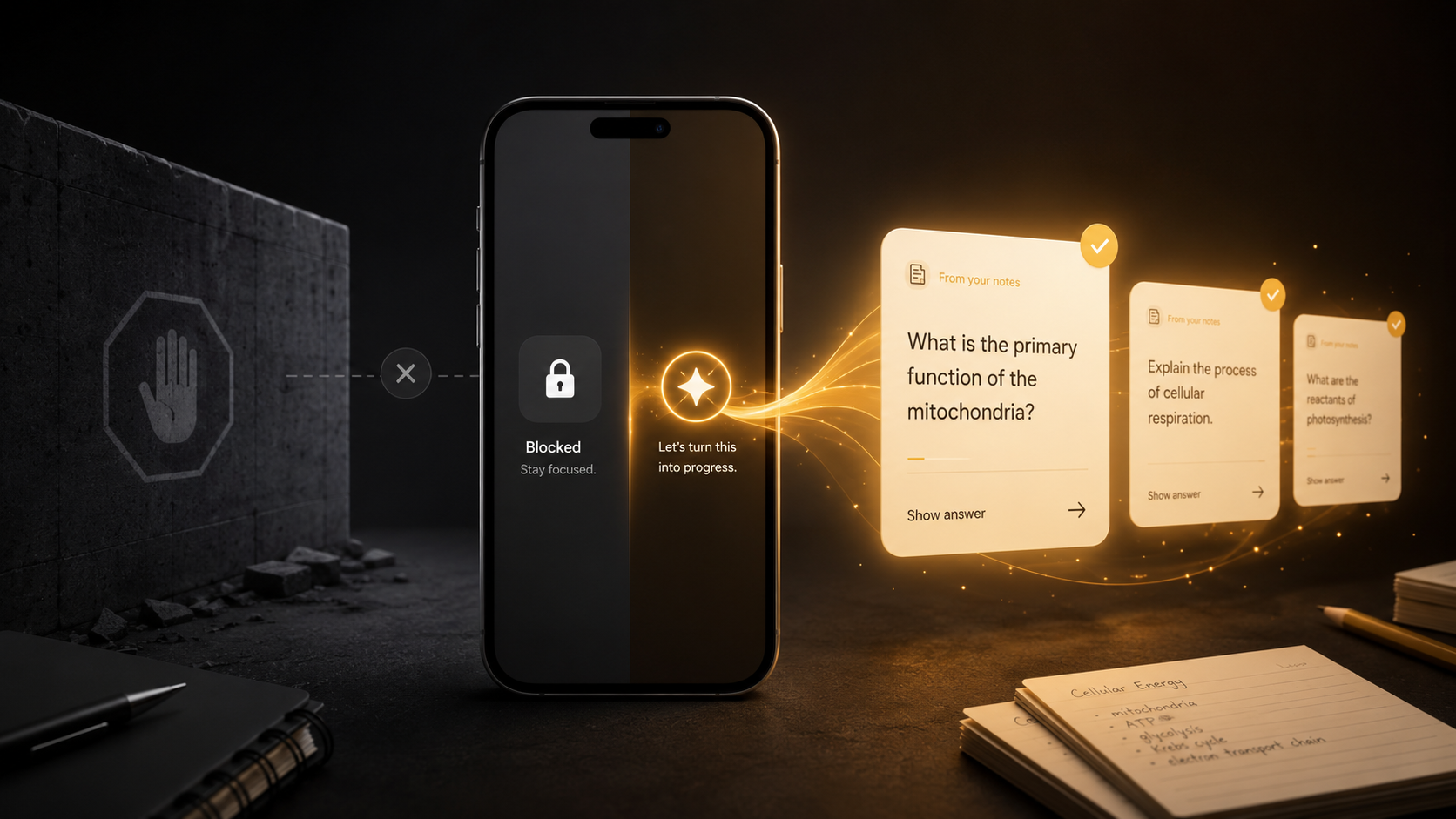
Icarus blocks apps the same way Opal and Forest do — you choose what’s locked, when, and how hard it is to get back in. The difference is entirely in what happens during the block. Instead of a countdown or a tree, you get a few review questions pulled from your own uploaded notes, content from community library, or past tests. You either answer them and get a little sharper on the class you’re actually behind in, or you decide it’s not worth it and close the app.
That’s the whole mechanism, and it sounds small until you notice what it changes: the block stops being pure friction and starts being time you get something out of, even on the days you don’t feel like resisting your phone at all.
The honest tradeoff
None of this makes Icarus strictly “better” — it makes it built for a different problem. If what you actually want is a clean habit tracker and a satisfying visual for staying off your phone in general, Opal and Forest are good at exactly that, and I don’t think you need to replace either one for that use case.
But if the real reason you’re locking your phone is a specific exam, a specific class, a specific thing you’re behind on — a countdown or a tree doesn’t move you any closer to that, no matter how good it feels to watch it grow. That gap is the entire reason Icarus exists.
Try Icarus — the block that turns into a study rep instead of just a wait.